The wait for CDCFIB recruitment is finally over for thousands of Nigerians who sat for the Civil Defence, Correctional, Fire and Immigration Services Board computer-based test last November. After months of silence, anxious calls to friends, and endless refreshing of the recruitment portal, the board has finally made an announcement. A new press release from the board’s secretary, Maj Gen A M Jibril (Rtd.), confirms that the recruitment train is moving to its next station: physical screening and document verification.
If you applied for a position in the Nigeria Security and Civil Defence Corps (NSCDC), the Nigerian Correctional Service (NCoS), the Federal Fire Service (FFS), or the Nigeria Immigration Service (NIS), this update concerns you directly. And honestly, you should treat it like the lifeline it is, because the next few weeks will decide whether your paramilitary dream becomes reality or stays on paper.
Let me walk you through everything the announcement says, what it actually means in practical terms, and the smart steps you should take starting today.
Table of Contents
What the CDCFIB Press Release Actually Says
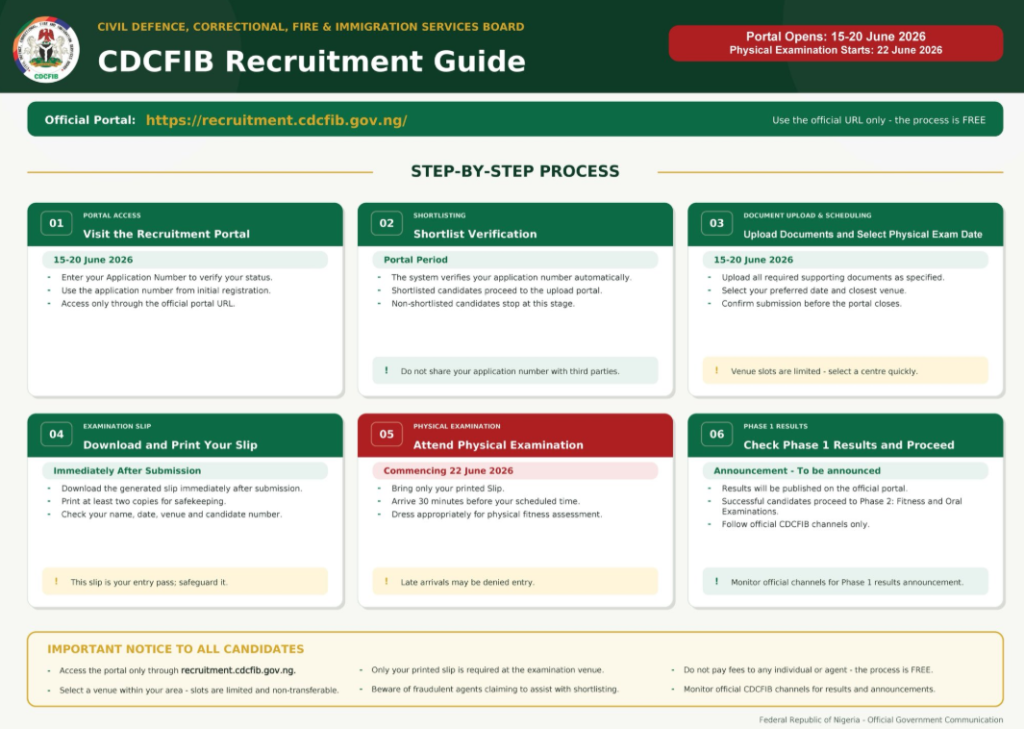
On 13th June 2026, the CDCFIB published a press release from the Office of the Secretary at the Old Federal Secretariat, Area 1, P.M.B 95 Garki, Abuja. The notice carries one central message: applicants who participated in the November 2025 Computer Based Test must now log into the official recruitment portal to verify their status.
The window opens on Monday, 15th June 2026, and closes on Friday, 20th June 2026. That gives candidates a full working week, no weekends, no extensions hinted at, to complete the status check. The portal address remains the same one applicants used during initial registration: https://recruitment.cdcfib.gov.ng.
The procedure is straightforward on paper. You log in with the Application Number you received when you first registered. The portal then tells you whether you were shortlisted. If your name made the cut, the system prompts you to upload your credentials and pick a date and venue for physical screening from the options provided.
Here is the part the Board hammered home with no room for confusion: the entire process costs absolutely nothing. Not one naira. Anyone asking you to pay for shortlisting, venue allocation, document upload, screening access, or final selection is a fraudster, plain and simple.
Why This CDCFIB Recruitment Stage Matters
A lot of applicants celebrated wildly after writing the November CBT, and rightly so because sitting for that exam was itself a feat. But here is something many candidates underestimate: the CBT is essentially a filter, not a finish line. The physical screening stage is where the recruitment exercise gets serious.
Think about it this way. The CBT tested whether you could answer questions correctly under pressure. Physical screening tests whether your body, your documents, and your identity match what you claimed on your application form. A candidate who scored 90% in the CBT but cannot produce a valid birth certificate, or who falls short on height requirements, will be dropped without sentiment.
I remember a friend who applied during a previous recruitment cycle. He aced the aptitude test, traveled all the way from Sokoto to Abuja for screening, and got disqualified because his NIN slip carried a different surname spelling from his WAEC certificate. One letter. That was all it took. He had to wait three more years for another opportunity.
That story is not isolated. Every recruitment cycle produces hundreds of such cases. The screening officers are not being wicked; they are simply doing what the law requires. So this is your moment to make sure every piece of paper, every measurement, and every claim lines up perfectly.
Step by Step: How to Check Your Status on the Portal
Let me break down the verification process in a way that even your uncle in the village can follow.
- First, gather your Application Number.
This is the unique code generated when you initially registered for the recruitment. It usually came in an email confirmation or appeared on the screen after you submitted your application. If you cannot find it, check your email inbox, including the spam folder, for any message from CDCFIB or the recruitment portal.
- Second, use a stable internet connection
Government portals tend to slow down or crash when millions of applicants hit them at once. Avoid the temptation to check at exactly 8 a.m. on Monday morning when everyone else is doing the same. Try late evening or early dawn for smoother access.
- Third, type the URL directly
Do not click links sent to you on WhatsApp, Telegram, or Facebook claiming to be the official portal. Open your browser and type https://recruitment.cdcfib.gov.ng yourself. Bookmark it once you confirm it is the real site.
- Fourth, log in carefully.
Enter your Application Number exactly as it appears, paying attention to upper and lower case letters if applicable. If the system rejects your details, do not panic and start re-entering frantically. Take a breath, double check the number, and try again.
- Fifth, read everything on the screen.
Once you log in, the portal will display your status. If you are shortlisted, instructions for the next steps will appear. Read every word. Screenshot the instructions. Save them somewhere you won’t lose them.
What to Do If You Are Shortlisted
Congratulations, but the work is just beginning. Being shortlisted means you have permission to attend physical screening, not that you have been recruited. Many applicants who were shortlisted in previous exercises still failed at the screening venue because they took the shortlist for granted.
The portal will ask you to upload your credentials. This means scanning or photographing your documents and submitting them through the system. Prepare the following before you even log in:
- Birth certificate or declaration of age
- Primary school leaving certificate
- WAEC, NECO, or equivalent secondary school certificate
- NYSC discharge certificate (for graduate positions)
- Degree certificate or statement of result (where applicable)
- National Identification Number (NIN) slip
- Local government identification letter
- Recent passport photograph with white background
- Medical fitness certificate from a government hospital (some categories require this upfront)
Scan these documents in clear, readable format. Blurry scans get rejected. PDF format usually works best, and keep each file under whatever size limit the portal specifies.
After uploading, you will be asked to pick a date and a venue for the physical screening. Choose wisely. Pick a venue you can reach comfortably, factoring in travel time, accommodation if necessary, and the cost of getting there. Do not pick Lagos if you live in Maiduguri just because Lagos sounds prestigious. The screening officers do not care where you choose; they care about whether you show up prepared.
What to Do If You Are Not Shortlisted
This is the part nobody likes to talk about, but it must be said. Thousands of applicants will check their status and find out they did not make the list. If that happens to you, here is the truth you need to hear.
Not being shortlisted does not mean you are not good enough. The paramilitary services receive applications in numbers that dwarf the available slots. A single state command might have 200 openings against 50,000 applicants. The mathematics simply does not favor everyone.
Take the news with maturity. Do not curse the system, do not blame “connection,” and do not start cooking up conspiracy theories. Instead, do these three things:
- Save your application number and any communication from the portal for your records.
- Identify what might have weakened your application, perhaps your CBT score, your educational qualifications, or your physical requirements.
- Keep your documents ready for the next recruitment cycle, which usually opens within one to two years.
Many serving officers today applied two, three, even four times before getting in. Persistence matters in this field.
The Free CDCFIB Recruitment Promise
The Board’s emphasis on the zero-cost nature of this exercise deserves its own discussion. Year after year, recruitment scams in Nigeria rob desperate job seekers of millions of naira collectively. The script is always the same. Someone calls you claiming to be from the board, or a “well-connected” agent says he can guarantee your slot, or a Facebook page promises to “upload your name” for a fee.
Let me say this in the clearest language possible: nobody, absolutely nobody, can secure a recruitment slot for you in exchange for money. Not your uncle’s friend in Abuja. Not the man who claims to know the Director General. Not the lady in the WhatsApp group selling “verified slots.” If they could really do it, why would they need your fifty thousand naira?
The Board itself has stated unambiguously that no fee should be paid to any individual, agent, group, or organization. Anyone offering to help you with shortlisting, venue allocation, document upload, screening access, or final selection is running a fraud. Walk away. Block the number. Report to the EFCC if you must.
Here is a practical test you can apply. Ask the person to put their promise in writing on official Board letterhead, signed by the Secretary to the Board. Watch how fast they disappear. Genuine recruitment has no middleman.
How to Spot Fake CDCFIB Recruitment Messages
Scammers have become creative. Some create cloned websites that look almost identical to the official portal. Others send official looking SMS messages with logos and reference numbers. A few even set up call centers that mimic government offices. Here is how to tell the real from the fake.
The URL test. The official portal is https://recruitment.cdcfib.gov.ng. Anything with extra letters, hyphens (sorry, I mean dashes), or different extensions like .com, .net, or .org is fake. Government portals end with .gov.ng.
The payment test. The real Board will never ask you to pay for anything during recruitment. Any message requesting money for any reason is automatically a scam.
The grammar test. Official communications are written professionally, with proper grammar, no spelling mistakes, and consistent formatting. Scam messages often contain odd phrasing, random capitalization, and broken English.
The urgency test. Scammers love to create panic. “Pay within 24 hours or lose your slot.” “Limited slots available, act now.” The real Board gives applicants reasonable time windows and never threatens immediate loss of opportunity.
The channel test. Official updates come through the recruitment portal and approved communication channels. The Board lists its verified handles in official press releases. Cross check any message against these channels before believing it.
Preparing for the CDCFIB Physical Screening Itself
Assume you have been shortlisted and have picked your venue. What happens next? The physical screening typically involves several components, and you need to prepare for each one.
- Height measurement.
Most paramilitary positions have minimum height requirements, often 1.65 metres for men and 1.60 metres for women, though specific roles may have different standards. If you are borderline, you will be measured rigorously. Do not try tricks like wearing thick socks or standing on tiptoe; the officers have seen every trick in the book.
- Physical fitness.
Some positions require a brief fitness assessment. This might include running a specified distance within a time limit, doing a set number of push ups, or completing other basic exercises. Start preparing your body now. Even daily brisk walks and basic calisthenics will help.
- Document verification.
Officers will examine every document you uploaded and compare it with the originals you bring to the venue. Discrepancies in names, dates, or signatures will be flagged. Make sure your NIN, birth certificate, school certificates, and any other identity documents tell the same story.
- Medical screening.
Be prepared for basic medical checks, including vision, hearing, and general physical health. Pregnant women, applicants with certain chronic conditions, and those with visible disqualifying features may face additional scrutiny.
- Background and identity verification.
The Board verifies that you are indeed the person who applied and that you have no criminal record. Bring a letter from your local government area chairman and any other identification documents requested.
Packing for the CDCFIB Screening Day
I cannot stress this enough: travel light but travel complete. Bring originals and photocopies of everything. Bring a black pen, a clear file folder, your application number printout, the portal confirmation slip, and a bottle of water. Wear comfortable clothes that allow for physical assessment, plain colors, no tight or revealing outfits, and proper enclosed shoes.
If you are traveling from far away, plan to arrive at least one day before your screening date. Sleep at a friend’s place or a budget hotel. You do not want to show up exhausted from an overnight bus ride, dehydrated, and disorganized. First impressions matter even in paramilitary recruitment.
Eat a light, nutritious meal on the morning of screening. Heavy oily food before a physical assessment is a recipe for embarrassment. Stay hydrated but not overhydrated.
What CDCFIB Recruitment Means for Nigeria
Beyond individual applicants, this recruitment exercise carries weight for Nigeria as a country. The four services under the CDCFIB umbrella, Civil Defence, Correctional Service, Fire Service, and Immigration, all face severe manpower shortages. Our prisons are understaffed. Border posts need more hands. Fire services in many states operate with skeleton crews. Civil Defence officers are stretched thin across multiple security challenges.
Every successful recruit becomes part of the solution to these problems. So when you prepare for your screening, remember you are not just chasing a salary. You are positioning yourself to serve a country that genuinely needs you. That mindset shift, from job hunter to potential servant of the nation, changes how you carry yourself during the entire process.
The Board’s commitment to a transparent, credible, merit based process also matters. For years, paramilitary recruitment in Nigeria carried a reputation for favoritism and shady dealings. The current leadership appears determined to change that narrative, and applicants like you, by refusing to pay bribes and following due process, become partners in that change.
Common Mistakes Applicants Make at This Stage
Let me list the most common mistakes I have seen applicants make during the verification and screening stage. Avoid these like you would avoid bad fuel.
- Logging in repeatedly when the portal is slow, which sometimes locks the account temporarily.
- Sharing their Application Number with friends or “agents” who promise to “help.”
- Uploading documents in the wrong format or with poor image quality.
- Choosing a screening venue based on prestige rather than accessibility.
- Believing rumors circulating on social media instead of checking the portal directly.
- Showing up at screening without all required original documents.Wearing inappropriate clothing or jewelry that does not align with paramilitary expectations.
- Arguing with screening officers when something does not go their way.
- Posting their full Application Number and personal details on social media in excitement, exposing themselves to identity theft.
Each of these mistakes has cost real applicants their slots in previous cycles. Learn from their experience so you do not repeat their errors.
FAQs
Can I check my status after 20th June 2026?
The press release specifies a window from 15th to 20th June 2026. While the portal may remain accessible after that, the Board has not promised extensions. Treat the deadline as firm.
What if I forgot my Application Number?
Search your email inbox thoroughly. If you cannot find it, look out for any portal feature that allows account recovery using your phone number or email. If all else fails, the official Board channels may provide guidance.
Can I change my screening venue after selecting one?
The press release does not address this directly. To be safe, choose carefully the first time. Once selected, plan as if no changes are possible.
Is there any fee for uploading documents?
No. Zero. Nothing. The Board has stated clearly that the entire process is free.
What documents must I have ready?
Standard identity, educational, and credential documents. Specific requirements may be detailed on the portal once you log in.
What if my name is misspelled on the portal?
Take screenshots and follow whatever correction process the portal provides. Do not ignore spelling errors because they can cause major problems at physical screening.
Conclusion
The journey from CBT to physical screening is long and emotionally draining. By the time you reach the screening venue, you will have spent months wondering, hoping, and probably losing sleep. Do not let all that effort go to waste through avoidable mistakes in the final stretch.
Verify your status within the official window. If shortlisted, prepare your documents meticulously. Choose a sensible screening venue. Show up early, dressed appropriately, with all originals and photocopies. Treat every officer you meet with respect, even when you are nervous. Answer questions honestly. Trust the merit based process.
And if this cycle does not end the way you hoped, hold your head high. You attempted something difficult, you learned the system, and you are now better positioned for the next opportunity. Many of the finest officers serving Nigeria today walked this same path, with the same setbacks, before earning their badges.
The Board has done its part by announcing the next stage clearly and emphasizing transparency. The rest is up to you. Open the portal on 15th June 2026, log in with confidence, and take the next step toward the career you have been working for.
Your future in uniform might just be one verified status away.